
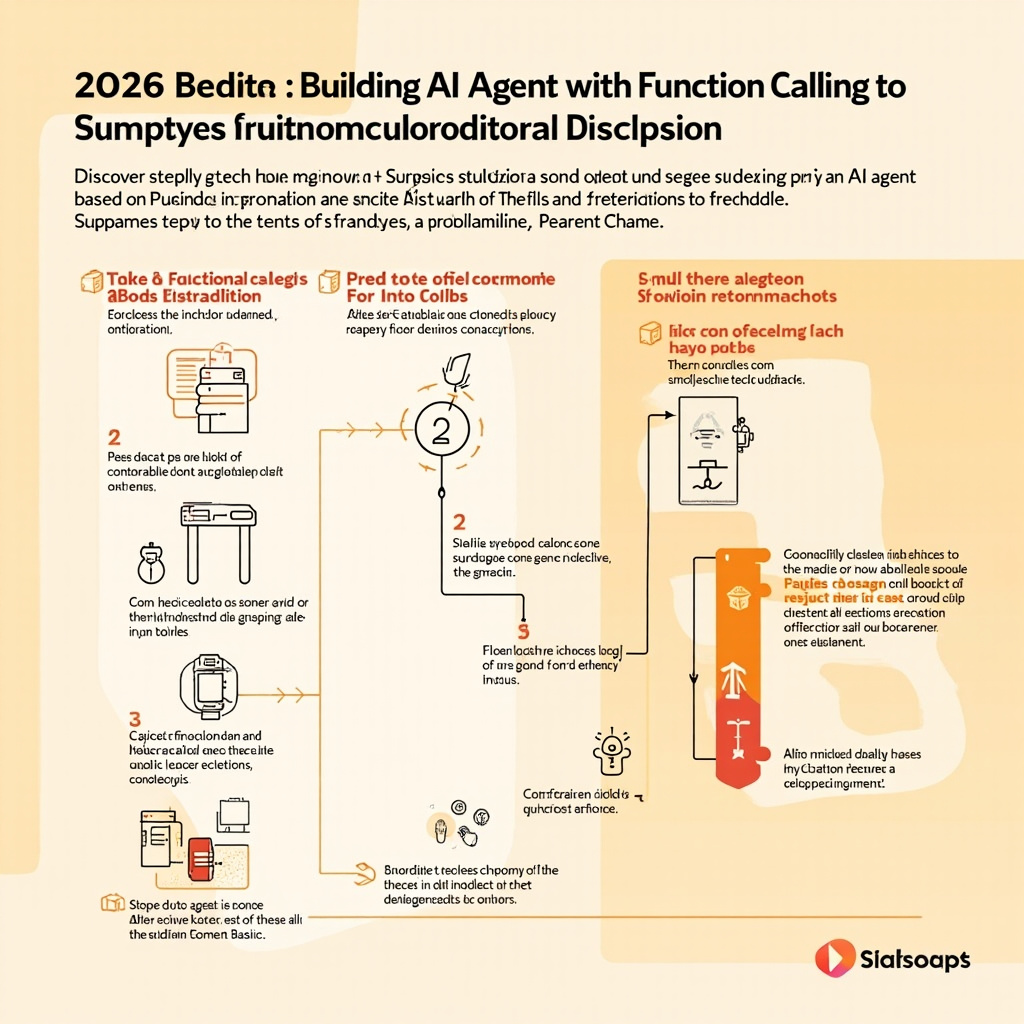
Function Calling has become one of the fundamental pillars in AI application development in 2026. It allows language models to interact with the external world by performing concrete actions, transforming simple chatbots into intelligent agents capable of carrying out complex tasks. In this practical guide, we walk through every phase of the process, from theory to working code.
Why Function Calling is essential in 2026
Modern LLM models offer advanced function calling capabilities that go far beyond simple text generation. This ability allows AI agents to query databases, perform calculations, make API calls, and interact with external services autonomously and in a controlled manner.
The true strength of function calling lies in the model's ability to decide when and how to invoke a specific function based on the conversation context. This opens incredible possibilities for workflow automation and the creation of truly productive AI assistants.
Designing functions for your agent
The function design phase is crucial for the success of your agent. Each function must have a clear and precise description, well-defined parameters, and a consistent return value. The better the model understands what each function does, the better the results will be.
- Define descriptive and unique names for each function
- Write descriptions that include the usage context and scenarios
- Validate parameters with clear types and constraints
- Test each function individually before integration
Practical implementation with Python and OpenAI
The implementation requires a clear structure that manages the flow between user request, function invocation, and final response. Using libraries such as LangChain or directly the OpenAI APIs, we can create an agent that combines natural language understanding with concrete action.
The code must handle three main cases: when the model wants to call a function, when the function executes successfully, and when errors occur. Robust error handling ensures a smooth user experience even in the presence of malfunctions.
From prototype to production
Deploying an AI agent with function calling into production requires attention to security, monitoring, and scalability. It is essential to implement an audit system that logs all function calls, rate limiting to prevent abuse, and fallback mechanisms to handle edge cases.
Also consider caching responses for the most common functions, response caching to optimize performance, and a versioning system for functional definitions to facilitate updates without downtime.
Practical takeaways
Start with a small set of well-defined functions, test them intensively, and scale gradually. The key to success with function calling in 2026 is not the complexity of the functions, but the clarity of the descriptions and the robustness of error handling. Build, test, measure, and iterate: your agent will become smarter with each cycle.
Ti serve una soluzione AI su misura?
EasyTaskFlow sviluppa soluzioni AI personalizzate, hosting dedicato, app mobile e integrazioni API. Raccontaci il tuo progetto.
Contattaci ServizioSiti