
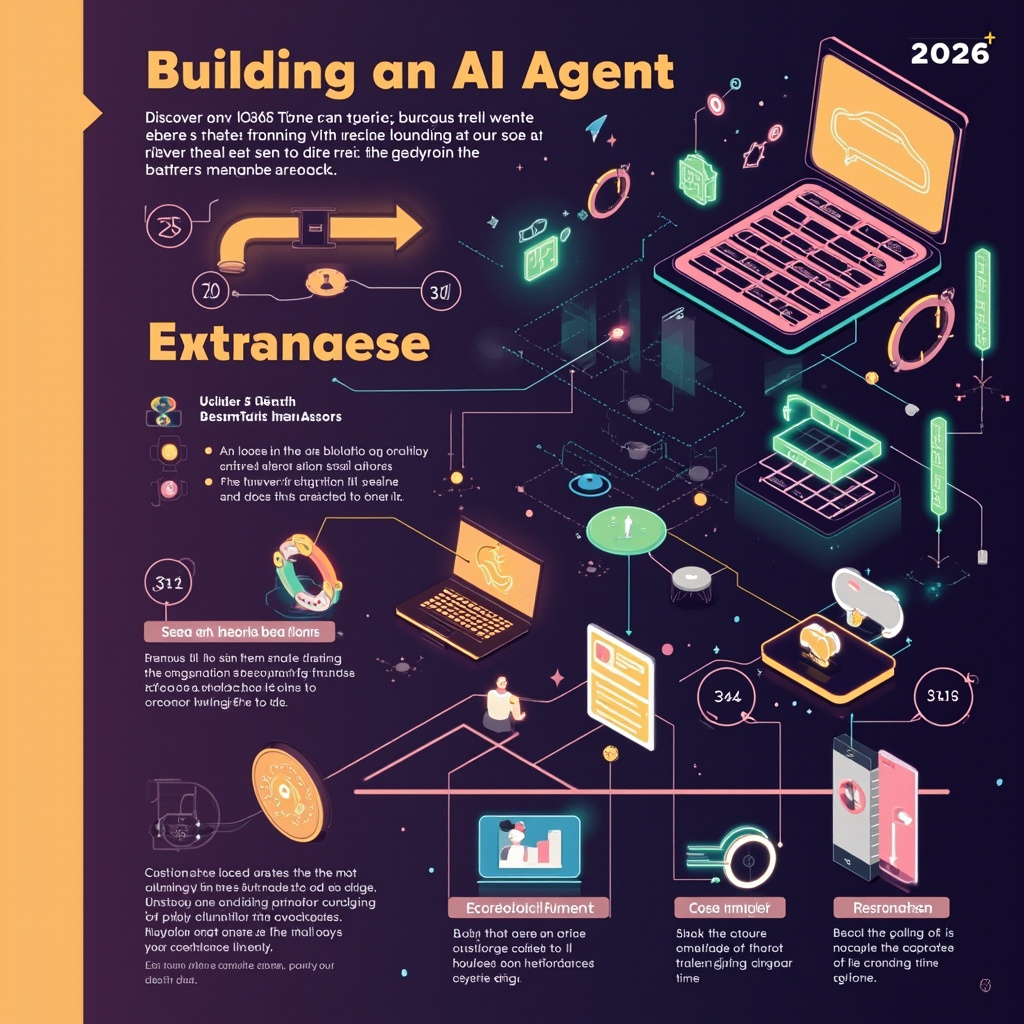
2026 marks a turning point in the evolution of AI assistants: no longer just text generators, but entities capable of interacting with the digital ecosystem through function calling. Building an agent that knows when and how to invoke external tools is now within reach of all developers, thanks to mature libraries and simplified APIs. This tutorial will guide you step by step in building an autonomous agent that combines linguistic reasoning and concrete action.
1. The fundamentals of function calling
Function calling is the ability of a language model to analyze a prompt, extract structured parameters, and generate a call to a user-defined function. Unlike traditional text responses, the agent produces JSON that describes which function to execute and with what arguments, allowing client-side code to intervene.
The benefits are immediate: greater precision in responses, integration with external databases, execution of complex operations, and creation of automated workflows. The model acts as a "brain" that decides when to delegate, while you provide the "limbs" through functions.
- Multi-step planning: the agent breaks a complex task into sub-actions executed sequentially.
- Real-time updates: retrieval of live data from financial, weather, or management APIs.
- Contextual automation: executing actions such as sending emails, creating events, or querying knowledge bases.
2. Model selection and configuration
In the 2026 landscape, the most reliable models for function calling include GPT-4o, Claude 3.5 Sonnet, and gemini-2.5-pro, all featuring native tool definition schema. The choice depends on the balance between latency, cost, and function complexity: for lightweight agents with ≤5 tools, mid-tier models offer the best trade-off; for orchestrating dozens of calls, top-tier models guarantee less parameter drift.
Typical configuration involves three elements: the system prompt that defines the agent's role, the list of functions with description and JSON-Schema schema, and the response handling mode (single-step vs. multiple loops). It is essential to test with variable payloads and observe how the model handles non-standard arguments or conflicts between tools.
3. Practical implementation with Python
We use the official library from the chosen provider (e.g., openai or anthropic) combined with a lightweight framework like langchain or pydantic to validate outputs. The basic flow is: Input reception → Chat completions with tool spec → Response parsing → Function execution → Feedback to the model. Here is an essential skeleton:
def call_weather_api(city: str) -> dict:
    # API call logic
    return {"temp": 22, "condition": "sunny"}

tools = [{"type": "function", "function": {"name": "weather", "parameters": {...}}}]
The full code includes error handling (timeouts, type failures), call logging, and circuit-breaker patterns to avoid infinite loops. For advanced scenarios, it is recommended to wrap each tool in a decorator that catches exceptions and returns structured messages to the agent.
4. Best practices and common errors
To keep the agent stable and predictable, adopt these habits: (1) describe functions with explicit input/output examples; (2) limit to 10-15 active tools per request to reduce confusion; (3) use a clear system prompt that defines the boundaries of each tool; (4) always validate received parameters before executing external calls.
The most frequent errors include poorly defined JSON schemas that generate missing parameters, callback loops when the model does not receive clear feedback, and over-trusting the output without validation. In case of anomalous behaviors, isolate the problematic tool and test it individually with adversarial prompts.
Practical takeaway: start with a single well-documented tool, build a mini evaluation loop, and only then scale to a broader set. An effective agent is above all a tested agent, not a collection of functions connected at random.
Ti serve una soluzione AI su misura?
EasyTaskFlow sviluppa soluzioni AI personalizzate, hosting dedicato, app mobile e integrazioni API. Raccontaci il tuo progetto.
Contattaci ServizioSiti