
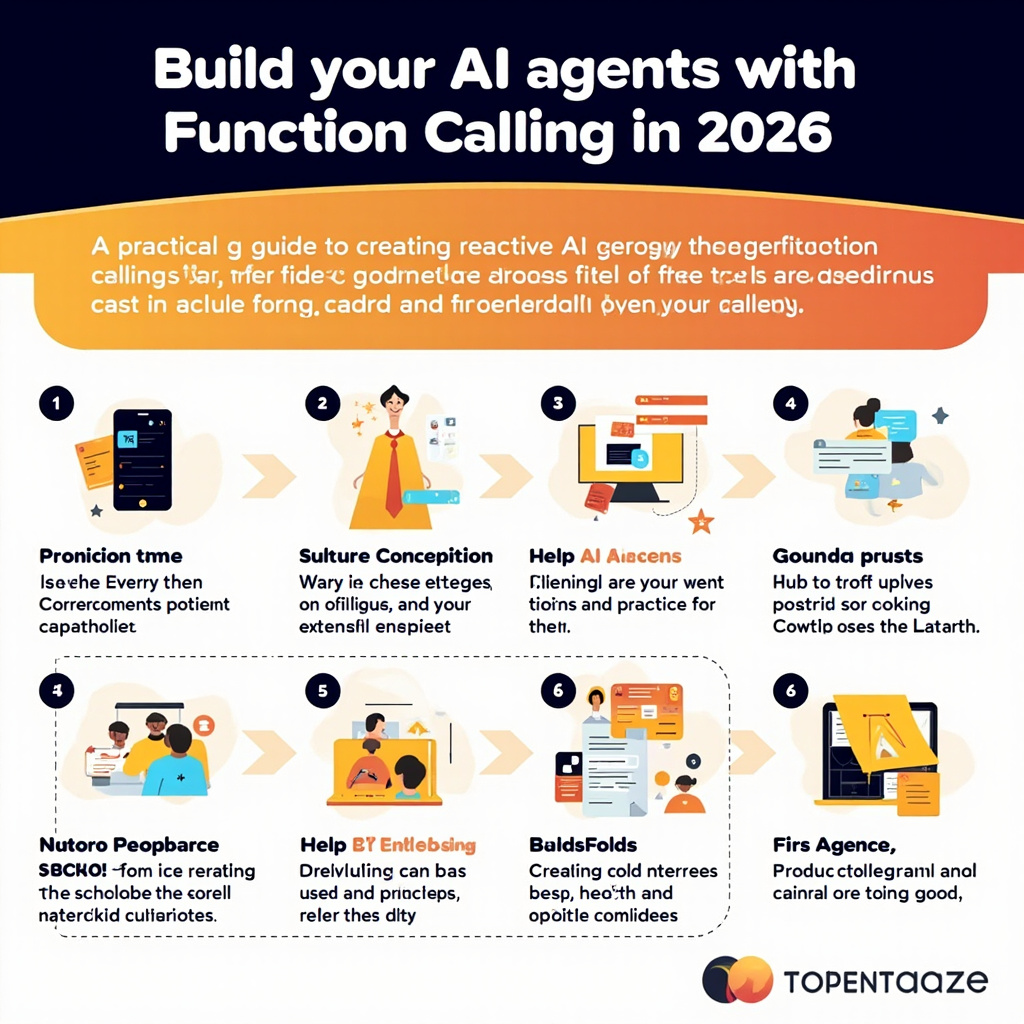
Function calling has transformed LLMs from simple chatbots into true action orchestrators. In 2026, building an agent with this capability is within reach of any developer: just a few lines of code are enough to connect a model to external tools, databases or service APIs. In this guide we'll see how to give your agent «hands and eyes» in a modular, scalable and production-ready way.
1. Choosing the right model for your use case
The choice of backend is crucial: there are lightweight open-source solutions (Llama 3, Mistral) and enterprise APIs (GPT-4o, Claude, Gemini). For function calling, evaluate the quality of structured responses, latency and cost per token. The latest generation models support complex JSON schemas, multiple parameters and multiple calls in a single turn.
If your project requires real autonomy, opt for a model that exposes features such as native tool-use, JSON mode or constrained grammar. This saves you post-processing and reduces parsing errors. Always test call samples on real datasets before moving to production.
2. Defining the tools (function schema)
Every capability must be translated into a well-documented function. Use the JSON Schema standard to describe name, parameters, types and clear descriptions. Best practices: snake_case names, result-oriented descriptions and client-side input validation.
- Try to limit the number of functions to 10-15 to avoid congesting the context window.
- Avoid overloading: one function, one purpose.
- Add call examples in the prompt to stabilize behavior.
During testing, manually validate schema outputs and measure invocation accuracy. If you notice drift, update the function descriptions or introduce few-shot examples in the system prompt.
3. Orchestration and state management
An agent with function calling becomes an asynchronous loop: it receives input, decides whether to call a function, collects results and returns to the model. To manage this logic in a robust way, adopt frameworks like LangGraph, CrewAI or custom pipelines based on React/Agent.
Important: track conversation state and intermediate results to enable retry, logging and debug. Use ephemeral queues (Redis, SQLite) to store transient state without weighing down API calls. Also consider circuit breaker mechanisms when external dependencies are critical.
4. Security, governance and testing
Before exposing an agent to the public, protect it: validate user input, limit function permissions and isolate sensitive calls. Implement a policy engine that blocks unauthorized invocations and monitors costs in real time.
For testing, use automated setups with extreme cases and fuzzing on schemas. Set up success metrics such as function completion rate, choice accuracy and average response time. A rollback strategy and audit log are a must for production versions.
Practical takeaway
Start with a single well-defined tool, then scale gradually. Use an orchestration framework, track everything and validate it with end-to-end tests. Function calling is not just a feature, it is the foundation of the autonomous agents of the future.
Ti serve una soluzione AI su misura?
EasyTaskFlow sviluppa soluzioni AI personalizzate, hosting dedicato, app mobile e integrazioni API. Raccontaci il tuo progetto.
Contattaci ServizioSiti